
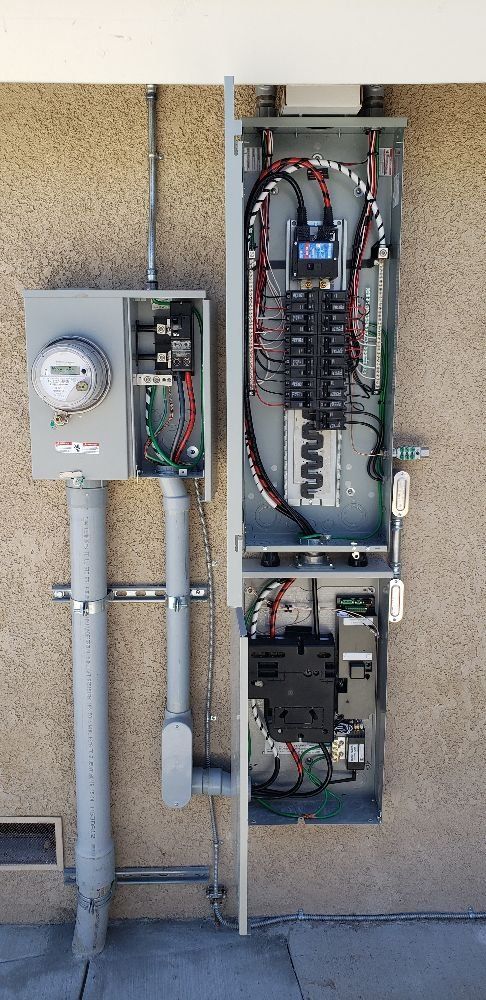
A portable generator should feed your house wiring only through a transfer switch or an interlock listed for your panel, installed by a licensed electrician, with a weatherproof inlet outside for the generator's cord. Both do the same essential job, making sure the house runs on either the utility or the generator but never both at once; the difference is how you choose which circuits stay on.
Our article on solar panels in an outage covers batteries and solar; this one covers connecting a portable generator the right way.
What backfeed is, and why outlet connections are dangerous
When the grid goes down, your house is still connected to the utility's lines, and power from a generator plugged into the house wiring can flow out onto them. That is backfeed.
SCE's generator safety page says never to power your home by plugging a generator into a wall outlet or temporarily wiring it into the electrical panel, because backfeed is extremely dangerous and can electrocute you, your neighbors or utility workers. The Consumer Product Safety Commission's generator safety alert gives the same warning, and OSHA's fact sheet notes that a generator attached without a properly installed transfer switch can energize wiring for great distances.
A cord with a plug on both ends, made for feeding a dryer or wall outlet, is exactly what these warnings describe. Don't use one. Building departments agree: the City of Placerville's portable generator handout says backfeeding outlets without a permanently installed transfer switch is not permitted.
The rule in plain words
A generator that powers house wiring is a second source, and transfer equipment has to keep it separate from the utility. The Placerville handout cites Article 702 of the California Electrical Code and requires transfer equipment and power inlets that are UL listed. The City of Fairfield's generator checklist states the goal: an interlock system that prevents accidental interconnection of utility and generator power. Your local building department sets the details for your address.
SCE puts it simply: the only recommended way to connect a generator to house wiring is to hire a licensed electrician to install a power transfer switch.
Option 1: a manual transfer switch
A manual transfer switch mounts beside your main panel and is wired in advance to the circuits you pick, such as the refrigerator, some lights or a gas furnace blower. Outside, a weatherproof inlet takes the generator's cord.
In an outage, you set the generator up outdoors, plug it into the inlet and move the switch's circuits to generator. The switch keeps them from connecting to both sources at once.
Good fit when: you want a short, fixed list of circuits, or your panel has no interlock kit listed for it.
Tradeoff: only the circuits wired to the switch can run on the generator.
Option 2: a panel interlock with a power inlet
An interlock is a mechanical plate mounted on the front of your panel. A breaker in the panel is dedicated to the generator, fed from the outdoor inlet, and the interlock physically prevents the main breaker and that generator breaker from being on at the same time.
In an outage, the main breaker goes off, the generator breaker goes on, and you turn on only the circuits the generator can carry. You do all of this from the breaker handles on the front of the panel, with its cover in place; installing the interlock, inlet and generator breaker is electrician work, and your electrician shows you the sequence for your panel. Every circuit is available, but you choose what runs.
Good fit when: your panel has a listed kit and a space for the generator breaker, and you want flexibility, such as the well pump in the morning and the microwave at dinner.
Tradeoff: it depends on you not to turn on more than the generator can take. A kit not made for your panel model doesn't qualify.
Standby generators and automatic transfer switches
A permanently installed standby generator connects through an automatic transfer switch: when the grid drops, the generator starts and the switch moves the house, or chosen circuits, over to it. SCE notes that permanently installed stationary generators are better suited for backup power, and that even a properly connected portable generator can become overloaded or overheated.
We don't sell generators; we connect the portable or standby generator you own or plan to buy.
Working out what you want to run
- List the essentials. Refrigerator, some lights, the router, phone charging, perhaps a furnace blower or well pump.
- Check the generator's ratings. Motors draw extra power for a moment as they start, so the starting rating matters as well as the running rating.
- Leave margin. SCE advises choosing a generator rated for more power than you think you will need.
- Review the load with your electrician. Central air, electric ranges, dryers and EV chargers usually stay off.
Who does what
You: choose and buy the generator, keep fuel safely and run it outdoors.
Your electrician: Infinity Electrical Inc. (CSLB #1100231) installs the inlet and the interlock or transfer switch, connects the circuits and matches the equipment to your generator. Permit and inspection steps are coordinated as part of the job.
The utility: SCE says California state law requires you to notify it first, by calling 1-800-655-4555, if you permanently wire a generator to your home. LADWP's backup generator and transfer switch request page says customer-owned emergency or standby generator installations must be reviewed and approved by LADWP engineering. Burbank, Glendale, Pasadena and other city utilities set their own rules; our backup power page covers each, and we tell you which applies to your address.
Before a shutoff: a safe checklist
- Sign up for alerts. SCE says it begins sending shutoff notifications up to three days in advance; anyone can sign up for address-level alerts on SCE's PSPS page. LADWP customers can get outage alerts through their LADWP account.
- Test-run the generator outdoors. Never in a home, garage, basement, crawlspace or shed, even with doors or windows open. CPSC says to keep it at least 20 feet from doors, windows and vents, and OSHA recommends 3 to 4 feet of clear space on all sides and above it.
- Install carbon monoxide alarms. CPSC recommends battery-operated alarms, or plug-in alarms with battery backup, and testing them monthly.
- Handle fuel carefully. CPSC says never to store generator fuel in the home and to turn the generator off and let it cool before refueling. Keep it in labeled containers made for fuel.
- Keep the area clear. SCE says no flammable materials or vegetation nearby.
FAQ
Can I plug my generator into a dryer outlet if I turn off the main breaker?
No. SCE and CPSC both say never to power a house by plugging a generator into an outlet, because it can backfeed onto the utility's lines; the safe connection is an inlet with a transfer switch or a listed interlock.
Is an interlock as good as a transfer switch?
It does the same job when it is a kit listed for your panel and installed by an electrician. Both physically prevent the utility and the generator from feeding the house at the same time; the interlock uses your panel's breakers, the transfer switch uses circuits wired to it in advance.
Do I need to tell the utility about my generator hookup?
Usually, yes. SCE says state law requires you to notify it before a generator is permanently wired to your home, LADWP reviews customer-owned emergency or standby generator installations, and other city utilities set their own rules.
Planning a generator hookup
Tell us which generator you have or are considering, what you want running and what panel you have. Send photos with the estimate form or call (844) 430-7681. Free estimates on eligible work, and the price comes in writing before any work starts.