
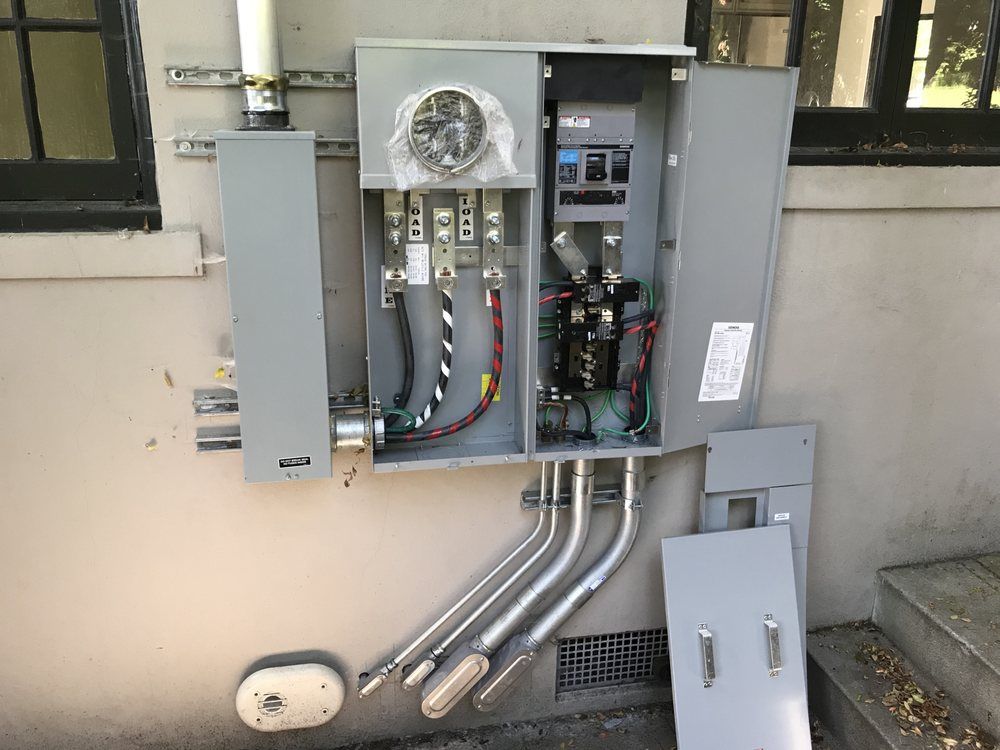
Not always. Whether a heat pump or an induction range needs a panel upgrade depends on two things: how much the new appliance draws, and how much room your electrical service (what the utility line and your main breaker can deliver) has left after everything else the house runs. Some homes on a 100- or 125-amp service can add one without a new panel; the load calculation and the equipment you choose decide it. Here is how an electrician works it out.
What each appliance needs
Induction range or cooktop. A 240-volt circuit, usually 40 amps; manufacturers' installation sheets list 40 amps for most ranges, and some allow 40 or 50. If you're replacing a gas range, this is a new circuit. If an electric range was there before, the existing circuit may already fit.
Heat pump for heating and cooling. The outdoor unit's nameplate sets the circuit. As one example, a common 3-ton model calls for a 30-amp maximum breaker, and across sizes the range runs from about 15 amps for a small ductless unit to 60 for a large ducted system. When a heat pump replaces a central air conditioner of similar size, the outdoor unit often draws about what the old one did, so the change on the panel can be small.
The number to ask about is backup electric heat in the indoor unit. Heat strips are rated in kilowatts: a 5 kW strip needs about a 30-amp circuit, and a 10 kW strip about 60. Southern California's mild winters mean a well-sized heat pump may need little backup heat, so ask whoever designs the system what strip size, if any, is planned. It is often the biggest number on the electrical side.
Heat pump water heater. Standard models use a 240-volt circuit, usually 30 amps, and some run on 15. There are also 120-volt models. Some need their own 15-amp circuit, and at least one is designed to plug into an existing outlet on a shared circuit, so check the spec sheet before you buy.
Heat pump dryer. Some run on 120 volts and plug into an ordinary 15-amp outlet; others need 240 volts. Either way they usually draw far less than a standard electric dryer.
Battery-assisted induction. A few ranges and cooktops now have a battery built in and plug into a regular 120-volt outlet, drawing on the battery when you cook on high. They can avoid a new 240-volt circuit entirely.
How an electrician decides: the load calculation
The code gives two ways to check whether your service can take the new load, and load management can change the answer. Our article on EV chargers and 100-amp panels walks through both with a charger; the same math applies here.
Adding up the house. For an existing home, the code's optional method totals the house's loads, from lighting and kitchen circuits to every fixed appliance, and applies an allowance for the fact that a house never runs everything at once. New heating or air conditioning is counted in full, without that allowance.
Using the house's real history. Where a year of your utility's demand records is available, the code also lets an electrician start from the highest 15-minute demand the house actually reached, add a 25 percent margin, then add the new load. If those records aren't available, a 30-day recording at the panel can stand in, though not on a home with solar panels. For a house that has never run hard, this can show room the paper calculation doesn't.
Load management. Since the 2023 edition, which California adopted for 2026, the electrical code recognizes energy management systems: listed equipment (tested and certified by a national testing lab) that keeps the house's total load under a set limit, for example by pausing a water heater while the range is on. Where one is installed, the limit it enforces can be used in the calculation.
Ways to avoid or put off a panel upgrade
- Pick lower-power equipment. A 120-volt heat pump water heater, a 120-volt heat pump dryer or a battery-assisted induction range can each remove a 240-volt circuit from the plan. Expect slower hot-water recovery and longer drying times, and some still need their own 120-volt circuit, so check the spec sheet.
- Take credit for what you remove. Replacing an electric resistance water heater or dryer with a heat pump model lowers the load, and that frees room for something else.
- Share or limit the load. Circuit-sharing devices and energy management equipment let two large appliances share capacity, so only one runs at full power at a time. These products vary, so we check that the device is listed (lab-certified) for the use and that your building department will accept it.
- Plan everything at once. If a heat pump, an induction range and an EV charger are all on your list, do one load calculation for all of them. Upgrading once, or confirming once that you don't need to, beats finding out one appliance at a time.
When a panel upgrade is the right call
An upgrade makes sense when the calculation says the house is already near its limit, when there's no room in the panel for new breakers, or when the panel itself is a problem: a Federal Pacific or Zinsco panel, corrosion, heat damage, or a 60-amp service. It also makes sense when several big electric loads are coming: a heat pump, induction cooking, an EV, an ADU.
Our article on Federal Pacific and Zinsco panels explains why those two get replaced, and our panel upgrade page covers how a replacement runs, including the utility's part: LADWP inside the City of Los Angeles, Southern California Edison in most surrounding cities.
Rebates and credits in 2026: check before you buy
Program money comes and goes, so confirm the current terms before counting on any of it.
- LADWP customers: the Consumer Rebate Program lists rebates for heat pump heating and cooling and for heat pump water heaters. Funds are first come, first served, and LADWP says rebates aren't guaranteed.
- SCE customers: SCE runs a pilot, authorized by the state utilities commission, that can pay for SCE's own equipment (lines, transformers, meters) when a panel under 100 amps is upgraded to no more than 200 amps, for customers in a low-income or equity electrification program who are switching at least two gas uses (space heating, water heating, cooking or clothes drying) to electric. It doesn't pay for your panel. The terms are on SCE's project requests page.
- State programs: California's statewide programs, TECH Clean California and the HEEHRA rebates, are fully reserved and not taking new reservations as of October 2026.
- Federal tax credit: the IRS says the energy efficient home improvement credit, which covered heat pumps and panel upgrades, isn't allowed for property placed in service after December 31, 2025.
- Other utilities: Anaheim, Azusa, Burbank, Glendale, Pasadena and Vernon run their own city utilities, and SDG&E serves parts of south Orange County. Each has its own programs, so check with yours.
What to send us
Open only the hinged panel door (never remove the inner cover or touch anything inside) and photograph two things: the label, usually inside the door, and the main breaker, the largest one, wherever it sits (some older panels have none). If you see scorching, rust or melted plastic, or smell burning, close the door and call us. Send the photos with the estimate form, along with the appliances you're considering (spec sheets help), or call (844) 430-7681. We'll do the load calculation on site and tell you whether your panel can take it, which lower-power options would help, or whether an upgrade is the better plan, with the price in writing.