
You plug something in and nothing happens. You try the next outlet: dead too. You go to the panel and every breaker is on. Often the fix takes thirty seconds once you know where to look. Here is the order to check things in, and the point where you should stop and call.
1. Find the GFCI that tripped
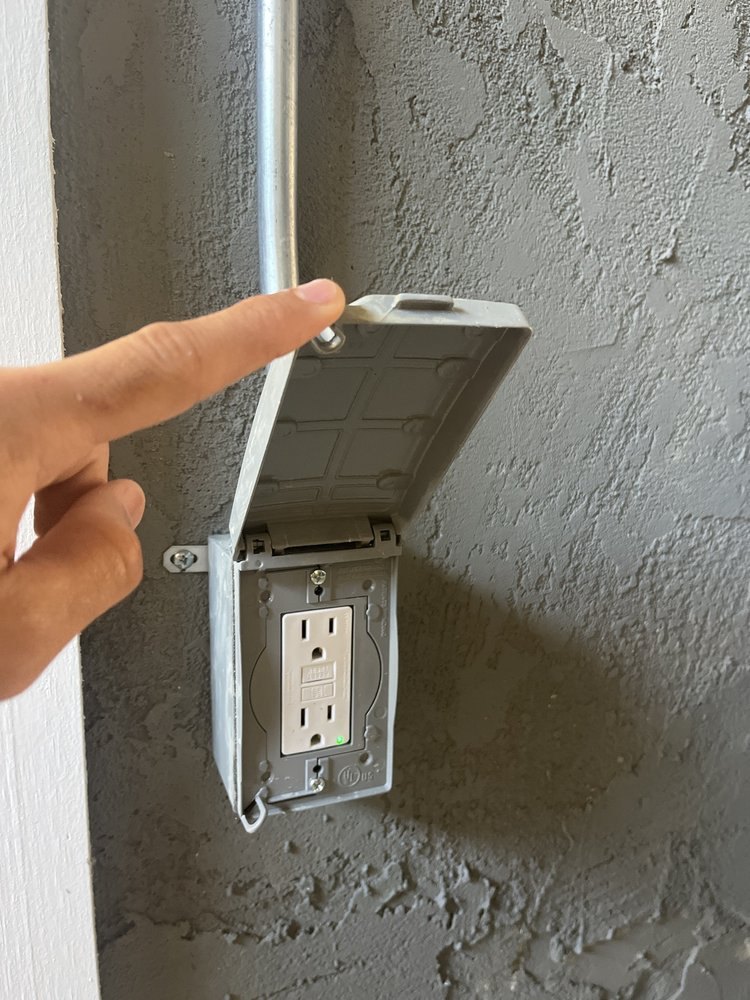
A GFCI outlet is the kind with "test" and "reset" buttons. It cuts power when it senses current leaking where it shouldn't, as little as a few thousandths of an amp, which is what protects you from a shock near water. What surprises people is that one GFCI can protect several ordinary outlets wired after it, and those outlets go dead with it.
That GFCI is not always in the same room. In a lot of Los Angeles houses, one GFCI in the garage protects the outdoor outlets; one in a bathroom can protect the outlets in a second bathroom; and kitchen counters may be split between two. Check every GFCI in:
- the kitchen
- each bathroom
- the garage
- outside, including the back patio and near the front door
- the laundry area
Press "reset" firmly until it clicks. If the dead outlets come back, you've found it. If the GFCI trips again straight away, something on that circuit is leaking current to ground, often a wet outdoor outlet or a damaged cord. Unplug everything on that circuit and try again. If it still won't hold, leave it off and call.
The U.S. Consumer Product Safety Commission's GFCI fact sheet recommends testing every GFCI once a month and after a power failure, which is a good habit anyway.
2. Check for a switched outlet
In many bedrooms and living rooms, one outlet, or the top or bottom half of one, is controlled by a wall switch so a lamp can be turned on from the door. If the dead outlet is near the doorway side of a room, flip the wall switches and try again. It sounds obvious, but it's easy to miss when you're in a hurry.
3. Look at the breakers again, closely
A tripped breaker doesn't always flip all the way to "off". Often the handle sits in the middle, which in a crowded panel looks almost like "on". Run your eye along the row for a handle that isn't lined up with the rest. To reset it, push it firmly all the way to "off" first, then back to "on".
Newer panels also have AFCI and GFCI breakers, with a small test button on the breaker itself. These can trip without the handle moving much. If one of them won't reset, or trips again within minutes, see our post on what a tripping breaker usually means.
4. If the GFCIs and breakers are fine: a loose connection
When every GFCI resets, every breaker is on, and a run of outlets is still dead, the usual cause is a failed connection at one outlet in the chain. Outlets on a circuit are wired one after another, so a burned or loose connection at one outlet cuts power to everything after it. Outlets with the wires pushed into holes in the back, rather than wrapped around the screws, are a frequent culprit as they age.
This is the point to stop. Finding the bad connection means turning off the circuit, opening outlets and testing, and a connection that has failed has usually been overheating for a while. It is a short, routine repair for an electrician, and it is exactly what our troubleshooting and repair service is for.
Stop and call now if you notice any of these
- An outlet or switch cover that is warm to the touch, discolored or scorched
- A burning or hot-plastic smell, or a buzzing or crackling sound
- Lights that get brighter and dimmer when something else turns on
- Half the house dead at once, or large appliances like the dryer, range or air conditioner not running while some lights still work
The last two can point to a problem with the neutral or with your electrical service, which can damage electronics and appliances. If half the house is out, call your utility's outage line first, since the fault may be on their side. For the rest, turn off the affected circuit if you can do it safely, and call (844) 430-7681.
What we do when we come out
We trace the circuit from the panel to find exactly where it stops, repair the failed connection, and check the other outlets on that run for the same problem, because they were usually installed the same way on the same day. If an outlet that should have GFCI protection doesn't, we'll point it out. Our outlets and GFCI page covers the rest of what we do with outlets and circuits, and small repairs are welcome. Free estimates are available for eligible work, and you get the price in writing before any work starts.