
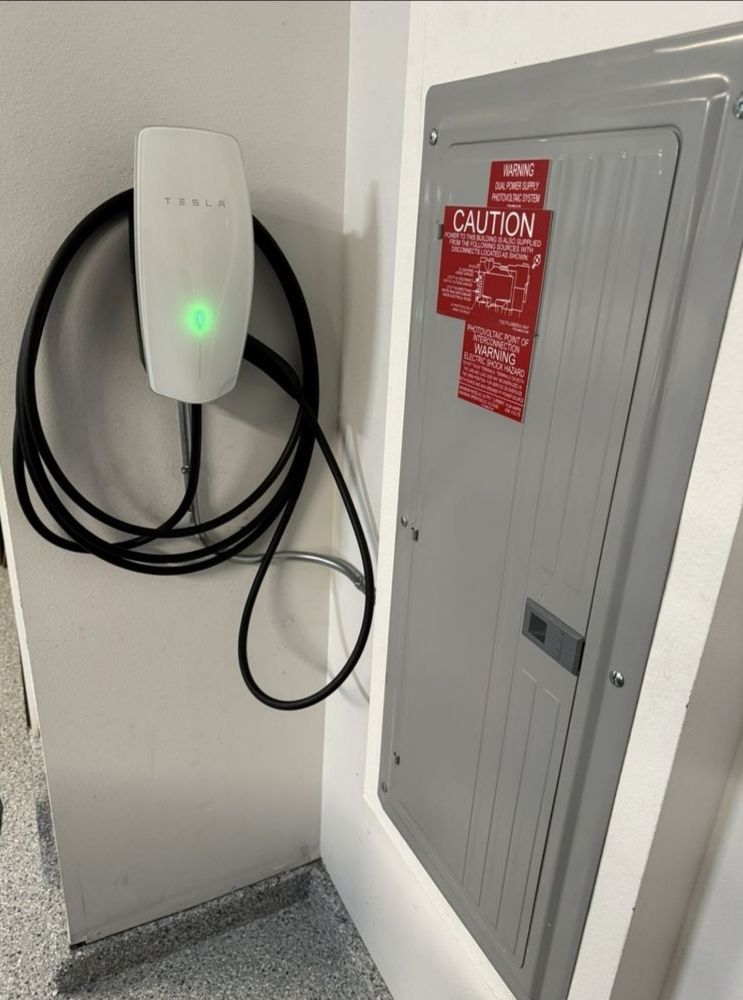
It's a common question when someone buys an electric car: "My house has a 100-amp panel. Do I have to upgrade it before I can install a charger?" The honest answer is that it depends on what else the house runs, and in a lot of homes the answer is no. Here is how an electrician actually works it out, and the options when the numbers are tight.
Why a charger is a big load
A Level 2 charger runs on 240 volts, the same kind of circuit as an electric dryer or range. Unlike a dryer, it can run at full power for hours. The electrical code treats it as a continuous load, which means the circuit has to be sized at 125 percent of what the charger draws. A charger set to 32 amps needs a 40-amp circuit; one set to 48 amps needs a 60-amp circuit.
On a 100-amp service, a 40-amp circuit is a big share of the total, but the number on the main breaker is not the whole story. What matters is how much the house actually needs at the same time.
How we work out whether your panel can carry it
Before we recommend anything, we do a load calculation. It adds up the house's floor area, the kitchen and laundry circuits and every fixed appliance: air conditioning or a heat pump, an electric range, water heater, dryer, pool pump, spa. The code then applies demand factors, because a house never runs everything at once, and gives a figure for the load the service has to carry. Add the charger, and either it fits under 100 amps or it doesn't.
There is a second way. Where your utility has a full year of usage records for the house, the code also lets an electrician start from your actual highest demand over that year, with a safety margin added, instead of the calculated figure. For a house that has never run hard, that can show room that the calculation alone does not.
As a rough picture: a 1950s or 1960s house with gas heat, a gas range, a gas dryer and a gas water heater often has room for a charger on a 100-amp service. Add central air, an electric range or a heat pump and it gets tight quickly. Original 100-amp services are common in the post-war tracts of the Valley, from Reseda and Tarzana to Granada Hills, so it's a question that comes up a lot here.
Your four options when the numbers are tight
1. A lower charging setting. Most Level 2 chargers can be set to a lower current at installation. At 24 amps (a 30-amp circuit) or 16 amps (a 20-amp circuit), the car charges more slowly, but a driver who plugs in every night usually has the range they need by morning. For most commuters, overnight is plenty of time. This is often the simplest answer, and it costs nothing extra.
2. Load management. A listed energy management system watches the whole house and turns the charger down, or pauses it, when the rest of the house is drawing a lot: the dryer, the oven and the air conditioning all at once. The code lets the charger's load be counted at the limit the system enforces, which is how a full-speed charger can fit on a smaller service. Some chargers have this built in with an add-on sensor; others use a separate device at the panel.
3. Sharing an existing 240-volt circuit. Listed circuit-sharing devices let the charger and another appliance, usually the dryer, share one circuit, with only one running at a time. It can avoid a new circuit entirely. These products vary, so before recommending one we check that it is listed for the use and that your building department will accept it.
4. A panel or service upgrade. If you plan to add more electric loads soon, such as a heat pump, induction cooking, a second EV or an ADU, upgrading from 100 to 200 amps may be the better money in the long run. It is a bigger job: a new panel and meter equipment, a permit with your city, and your utility (LADWP inside the City of Los Angeles, Southern California Edison in most surrounding cities) has to schedule the disconnect and reconnect. Our panel upgrade page walks through how that goes.
There is also Level 1: the cord that came with the car, in an ordinary 120-volt outlet on its own circuit. It adds only a few miles of range per hour, but for a short daily commute it can be enough while you decide.
When we recommend upgrading anyway
We suggest an upgrade when the load calculation says the house is already near its limit, when you have clear plans for more electric appliances, or when the panel itself is the problem. A Federal Pacific or Zinsco panel, a panel with no free spaces, or one with corrosion or heat damage should be replaced whatever you decide about the charger. Our article on Federal Pacific and Zinsco panels explains why.
Permits and rebates
A new charger circuit is permitted work everywhere in California, and we pull the permit. Our post on EV charger permits in Los Angeles explains how that works and which office issues it.
Two utility programs are worth checking before you buy, because both depend on how the job is done:
- LADWP customers: the Residential EV Charger Rebate Program has offered up to $1,000 toward a qualifying networked Level 2 charger, with funds first come, first served. It asks for proof of a finaled LADBS electrical permit, so the permit matters.
- SCE customers: Charge Ready Home has offered help with installation and with panel upgrades for income-qualified households and customers in designated communities. Check your eligibility, and whether the program is currently accepting applications, on SCE's site.
Program terms change, so confirm the current details with the utility before you count on a rebate. For a plain-language overview of home charging, the U.S. Department of Energy's charging at home page is a good place to start.
What to send us
Open only the hinged panel door (never remove the inner cover or touch anything inside) and take two photos: the label, usually inside the door, and the main breaker, the largest one, wherever it sits. If you see scorching, rust or melted plastic, or smell burning, close the door and call us instead. Send the photos with the estimate form, which has a photo field, along with your car and where you park. Or call (844) 430-7681. We'll tell you which of the options above fits your house, and the price comes in writing after the on-site visit. More on how we install chargers is on our EV charger installation page.