
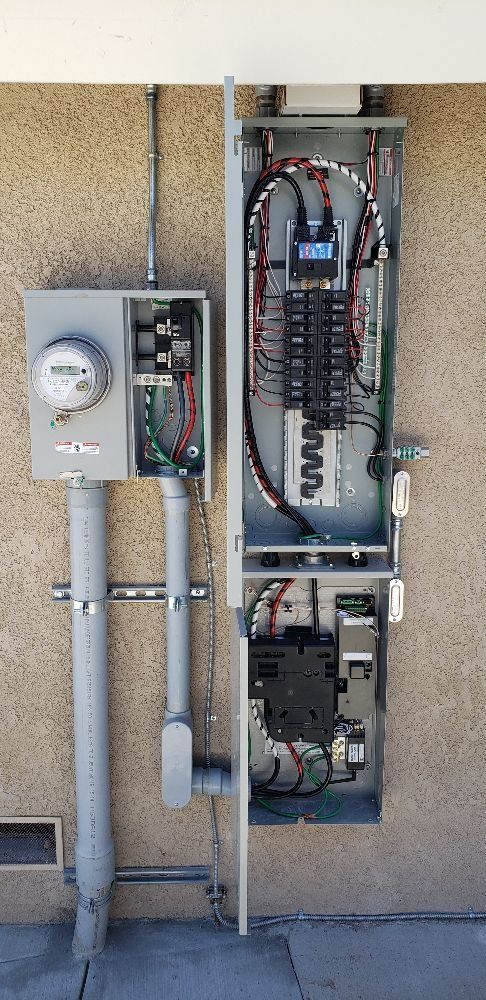
For most homes, a battery that runs a short list of essential circuits gives the longest, most dependable outage protection. Whole-home backup makes sense when the battery system is large enough, or the big appliances are managed, so they can't drain it in a few hours.
Our earlier articles cover the pre-shutoff checklist, generator hookups and solar in an outage; this one covers what a home battery should power.
Two numbers decide what a battery can do
- Power, in kilowatts (kW): how much it can deliver at once. This decides what can run at the same time, and whether a motor can start.
- Energy, in kilowatt-hours (kWh): how much it stores. This decides how long things run.
The Department of Energy's National Laboratory of the Rockies (formerly the National Renewable Energy Laboratory) describes residential batteries by both numbers and treats the ratio between them as storage duration in hours.
The CPUC's Public Safety Power Shutoff FAQ says runtime depends on the battery's size and on what your appliances draw, and that a single battery can typically run priority appliances such as a refrigerator, lighting and a few outlets for about 24 to 48 hours, that a larger multi-battery system can provide full backup power for 24 to 48 hours, and that solar extends the time when the sun is shining.
Option 1: an essential-loads (critical-loads) subpanel
The circuits you choose move from the main panel to a separate subpanel the battery carries. In an outage those stay on and the rest of the house goes dark.
SCE's SGIP residential fact sheet names typical loads to keep running: medical equipment, refrigeration, air conditioning, electric heating, lighting and electric well pumps. They won't all fit on one small battery, which is why you make a list.
Why it works: stored energy goes only to what matters, so it lasts longer.
Tradeoff: everything else is off for the whole outage, and moving circuits is electrician work. Plan reviewers check it; Newport Beach's plan-check comments ask for load calculations supporting the feeder and breaker sizing for a backup load panel, and AFCI protection for relocated wiring.
Option 2: whole-home backup
The backup equipment sits between the utility service and your main panel, so every circuit stays connected to the battery in an outage.
Tradeoff: every appliance that's on draws from the battery, including the biggest ones. Whole-home setups usually need more capacity, load management, or both.
The big loads that drain a battery
- Central air conditioning and heat pumps: large, long-running motor loads that draw extra power at startup.
- Electric ranges, ovens and dryers: high power while in use.
- EV chargers: can pull a large share of a battery's output for hours, which is why they're usually left off backed-up circuits.
- Well pumps: essential on a well, and a motor the battery must be able to start.
- Electric water heaters: a high-power heating load that can use a large share of a battery's stored energy.
To run any of these in an outage, size the battery for it or control when it runs.
Load management: the middle ground
Load management keeps big appliances connected but limits what runs at once, such as holding off the EV charger or dryer until the battery has room. Ask whether the system you're considering includes it.
A related tool, a listed energy management or power control system, can limit the current supplied to a panel to what its busbar and conductors are rated for. Whether one fits your panel is decided in design and plan review.
What your panel and service size have to do with it
A battery connects to your panel, and the panel has limits. Newport Beach's plan-check comments ask applicants to show the main bus rating and main breaker size, and to justify derating the main breaker with residential load calculations.
- A load calculation shows what the house actually draws, which drives both the battery choice and the connection.
- An older or full panel may lack room or capacity for the connection; some homes need a panel upgrade or a different connection point first.
- Your service size caps what the whole house can draw.
Keeping the house off the grid in an outage
A battery must not send power onto the utility's lines while crews may be working. The CPUC's FAQ says you must contact your utility if you intend to use backup power connected directly to your home's wiring, and, in its answer on generators, that you're responsible for making sure power doesn't flow into the utility's de-energized grid.
That's why a battery set up for backup includes equipment that separates the house from the utility while the grid is down. Names vary by manufacturer, so ask what it is and where it mounts.
Utility steps
A grid-connected battery needs the utility's approval before it runs, and those steps are coordinated as part of the job.
- SCE: storage is interconnected under Rule 21. SCE's Rule 21 checklist for an accelerated permission to operate applies to stand-alone storage not paired with solar, used only for peak shaving and backup, and set up not to export power to the grid.
- LADWP: its interconnection requests page covers battery storage projects, including "BESS only" categories and a BESS technical data form, and LADWP's checklist says the information must be submitted before interconnection can be provided.
- City utilities such as Burbank, Glendale and Pasadena set their own rules.
Battery with or without solar
You don't need solar for a backup battery. SCE's SGIP residential fact sheet says a battery can charge from the grid, and SCE's SGIP page says you don't need solar to qualify for that program. Without solar, though, the battery can't recharge during a long shutoff, so the essentials-or-whole-home choice matters even more.
Infinity Electrical doesn't install solar.
SGIP status: SCE administers the Self-Generation Incentive Program in its territory under the CPUC. SCE's page currently says the SGIP ratepayer budgets are closed to new applicants and the state-funded residential equity budget's funds are exhausted, with a waitlist. Check SCE's SGIP page before counting on it.
Where the battery goes
NFPA 855 is the national standard for installing stationary energy storage systems; in California, the Fire Code and Residential Code set the rules for homes, the manufacturer's instructions add their own, and your building and fire department decides what applies.
- Listing: Newport Beach requires home batteries to be listed and labeled to UL 9540.
- Not in living space: the 2025 California Residential Code, in effect since January 1, 2026, keeps home batteries out of bedrooms and out of closets or spaces that open directly into bedrooms, and limits them to garages, detached structures, outdoor walls a set distance from doors and windows, and finished utility spaces, each with conditions.
- Garages: Newport Beach requires impact protection for a battery in a garage or carport where a car could hit it, and the code calls for smoke alarms, or a heat alarm where a smoke alarm can't be used, where a battery is installed, including attached garages.
What to ask before you buy
- Subpanel or whole house?
- What are its kW and kWh, and can it start my largest motor?
- How long will my essentials run without solar?
- How are big loads managed?
- Can my panel take it?
- Does the planned location meet the fire code?
Who does what
Infinity Electrical Inc. (CSLB #1100231) installs and connects battery backup systems across Los Angeles, Orange and Ventura counties: the load calculation, the critical-loads subpanel or whole-home connection, the panel work and the backed-up circuits. We don't sell batteries or generators or recommend brands. Our backup power page covers batteries and generators.
FAQ
Can a home battery run my central air conditioner during an outage?
Only if it can deliver enough power to start and run it and stores enough energy to keep it going. Many setups leave central air off the backed-up circuits or manage when it runs.
Is a critical-loads subpanel or whole-home backup better?
A critical-loads subpanel is usually better for stretching a battery on essentials. Whole-home backup suits larger systems or homes that use load management to keep big appliances in check.
Do I need solar to get a backup battery?
No. SCE says a battery can charge from the grid, and its SGIP page says solar isn't required for that program, though SGIP is currently closed to new applicants or waitlisted; without solar, a battery can't recharge during a long outage.
Do I need the utility's approval to install a battery?
Yes, for a grid-connected battery. SCE handles storage under Rule 21, LADWP has its own interconnection process, and the system shouldn't run until the utility approves it.
Can the battery go in my garage?
Often, yes. California's code allows garages with conditions such as impact protection and alarms, while bedrooms, closets or spaces that open into bedrooms, and living spaces are off limits; your building and fire department has the final say.
Planning battery backup
Tell us what you want to keep running, what panel you have and which battery system you're considering. Send photos of your panel (open only the hinged door; never remove the inner cover) with the estimate form, or call (844) 430-7681. Free estimates on eligible work, and the price comes in writing before any work starts.