
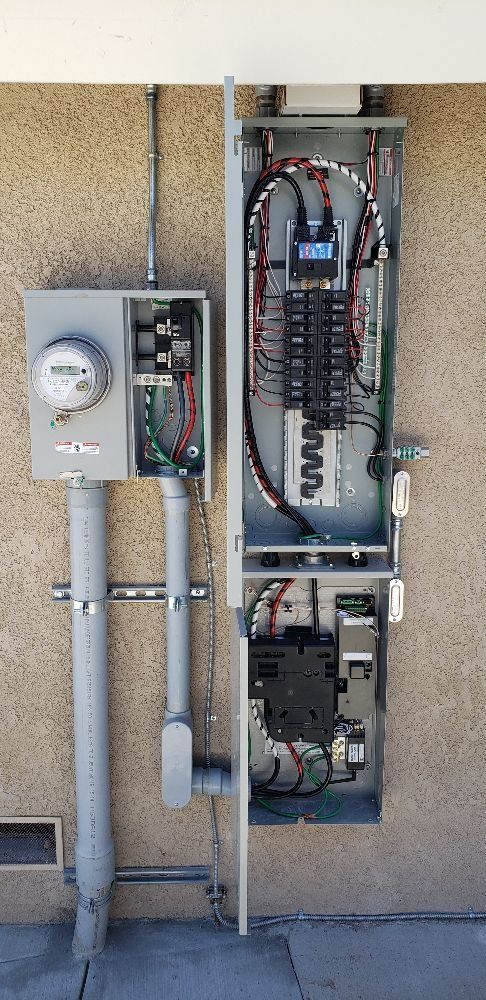
A subpanel is a second breaker panel fed from your main panel, so a garage, workshop or ADU gets its own breakers close to where the power is used. It does not add power to the house: the load calculation for the whole property decides whether the existing service can carry the new building, and if it can't, the service has to be upgraded or the new loads managed.
That one point decides most of the project, so it comes first here. The rest of this guide covers what changes when the building is detached, what an ADU adds to the question, and how to plan the job so it's done once.
What a subpanel does, and what it doesn't
A subpanel spreads circuits out. Instead of running every garage or ADU circuit back to the main panel, one feeder runs from a breaker in the main panel to the subpanel, and the circuits for that building start there. That saves long runs, leaves room for future circuits, and puts the breakers where the people using them can reach them.
What a subpanel can't do is make the service bigger. The main panel and the utility service still carry everything. Los Angeles County Building and Safety's ADU guideline (version 4.1, October 2024) puts it plainly for ADUs: a new service or an upgrade of the existing one "will not be necessary if residential load calculations are performed to confirm the existing service panel is sufficient," and if the new calculated loads exceed the rating of the existing service panel, an upgrade is required.
Step 1: Start with the load calculation
Before anyone picks a subpanel size, list what the new space will run. A few lights and outlets in a garage is a very different load from a car charger, a welder, a table saw, a mini-split, or an ADU with its own kitchen, water heater and laundry.
The calculation answers three questions:
- Can the existing service carry it? If yes, a subpanel fed from the main panel is usually the simplest design.
- If not, are there ways around a bigger service? Load management and lower-power equipment can sometimes keep a house on its current service. Our articles on EV chargers on a 100-amp panel and heat pumps and induction ranges walk through those options.
- If a bigger service is needed, the subpanel becomes part of a panel upgrade, which involves your utility. Our step-by-step guides cover LADWP and SCE.
Plan for what's likely next, too. If an EV charger or a heat pump is coming in a year or two, size the feeder and the subpanel for it now. Pulling a larger feeder later usually means opening the same trench or wall twice.
Step 2: Attached or detached changes the rules
Inside the house or an attached garage, a subpanel is fed from the main panel like any other feeder. For an attached ADU, LA County's guideline says new circuits can simply be added to the existing service panel, provided the load calculation confirms the added circuits are acceptable, so a subpanel is a convenience there, not a requirement.
A detached garage, workshop or ADU is a separate building in the electrical code, and that adds requirements:
- A grounding electrode at the new building. The code generally requires a grounding electrode system at a separate building fed by a feeder, as Electrical Contractor magazine's 2018 column on grounding at separate buildings explains. LA County's guideline says the same for a subpanel in a detached ADU.
- An equipment grounding conductor run with the feeder. A feeder to a separate building generally must include one. The older approach of grounding through the neutral survives only as a narrow exception for some existing installations, so a new feeder is planned with the grounding conductor from the start.
- A way to shut the building off at the building. For a detached ADU, LA County's guideline says a subpanel with more than six circuit breakers needs a main breaker, and that the main breaker must be rated at least 60 amps.
The route of the feeder matters as much as the panel. A run under a driveway or a yard means a trench and conduit; a run through an attic or crawl space has its own wiring methods. Utility lines, gas lines and irrigation in the path all affect where a trench can go, and the line is marked before anyone digs.
Step 3: An ADU adds the meter question
Many ADU owners ask whether the ADU needs its own meter. LA County Building and Safety's guideline answers it: no, a separate meter is not required by code, but the owner can request one. The guideline links a separate meter or service panel to a request for a separate address for the ADU, and says a junior ADU (built inside the main house) can't get a separate address or separate utility service, citing state law.
So there are two common designs:
- Fed from the house. A feeder from the main panel to a subpanel in the ADU. One bill, one service, and the load calculation has to cover both units.
- A separate service. A new service and meter for the ADU, arranged with the utility. That brings in the utility's own review and work on its side of the meter, much like the steps in our LADWP and SCE panel upgrade guides.
Which one fits depends on the property, the loads, the city's rules and the utility, so it's worth settling early with whoever is designing the ADU. Cities differ: LA County Building and Safety's guideline covers projects it permits (generally unincorporated areas and cities that contract with the County for building services), and each city's building department publishes its own requirements. See who handles your permit and power.
Where a subpanel can go
Location rules come up more often than people expect. LA County's guideline notes that circuit breakers, and the panels that house them, can't go in clothes closets or bathrooms. A panel also needs clear working space in front of it, and an outdoor panel has to be rated for wet or damp locations. In a garage, plan around the car, the workbench and storage shelves, because the space in front of the panel has to stay clear.
Safety: what not to do yourself
A subpanel is fed from the main panel, so the feeder connection is made inside the main panel. That is work for a licensed electrician with the power properly shut off and verified. Don't remove the main panel's inner cover, don't add a breaker to "see if it fits," and don't run an extension cord or a temporary cable to a detached building as a permanent solution. If a garage or ADU circuit is already warm, buzzing, or tripping, stop using it and call.
A checklist for planning the job
- A list of everything the space will power now and in the next few years
- A load calculation for the whole property, done before the subpanel is sized
- Attached or detached, and the feeder route (trench, attic or crawl space)
- For an ADU: fed from the house or a separate service, settled with the designer before the plans are final
- A panel location that isn't a closet or bathroom and leaves clear working space
- If a service upgrade is needed: the utility steps, which usually take more of the calendar than the installation
How we can help
Infinity Electrical Inc. (CSLB C-10 #1100231) plans and installs subpanels and feeders for garages, workshops and ADUs across Los Angeles, Orange and Ventura counties: the load calculation, the feeder and subpanel, the outlets and circuits in the new space, and a panel upgrade when the service has to grow, with the utility and building-department steps coordinated around the work. Free estimates on eligible work; call (844) 430-7681 or use the estimate form. Customer assistance in English and Spanish.
FAQ
Does a subpanel give my house more power?
No. A subpanel only spreads circuits out; the main service still carries every load on the property. A load calculation decides whether the existing service is enough, and if it isn't, the service is upgraded or the new loads are managed.
Do I need a subpanel for a detached garage or workshop?
Not always. A detached building with a light and an outlet or two can sometimes be fed by a single circuit. Once the space needs several circuits, such as a car charger, tools, heating or cooling, a feeder and subpanel are usually the cleaner design, and a detached building then needs its own grounding electrode and a way to shut it off at the building.
Does an ADU need its own electric meter?
Not under the code, according to LA County Building and Safety's ADU guideline; an owner can request a separate meter, which the guideline ties to a separate address for the ADU. A junior ADU inside the main house can't get separate utility service. Check your own city's rules, since each building department sets its own requirements.
Can I put a subpanel in a closet?
No. LA County's guideline notes that breakers and the panels housing them can't be located in clothes closets or bathrooms, and a panel needs clear working space in front of it.
How big should the subpanel be?
The load calculation decides it. Size the feeder and subpanel for what the space will run in the next few years, not just today, because a larger feeder later usually means opening the same trench or wall again.