
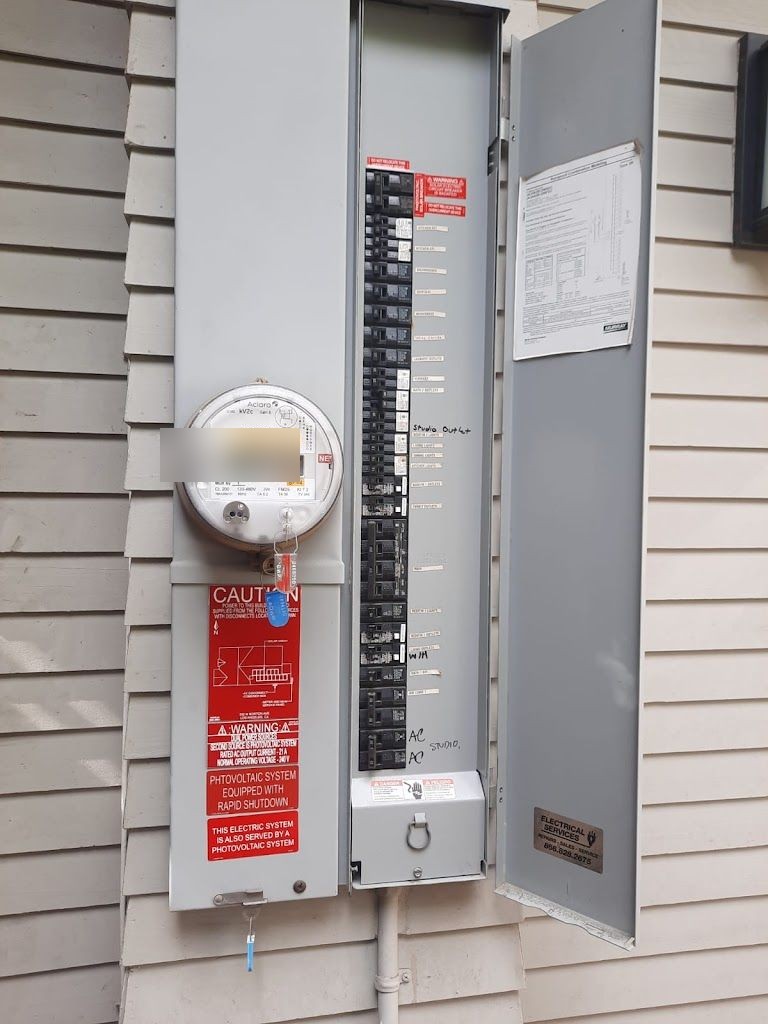
A panel upgrade in the City of Los Angeles runs through two city departments: LADWP, which owns the power up to your meter and decides where the new panel and meter can go, and the Department of Building and Safety (LADBS), which issues the electrical permit and inspects the work. The order is: size the new service, get LADWP's meter spot, install under an LADBS permit, pass the LADBS inspection, and then LADWP sets the meter and energizes the new service.
This guide is for homeowners whose power bill comes from LADWP: most of the San Fernando Valley, Hollywood, much of the Westside, the Eastside and the Harbor area. If you're in Burbank, Glendale, Pasadena, an SCE city or an unincorporated area, the steps are similar but the offices are different; see who handles your permit and power. Rebuilding in Pacific Palisades has its own LADWP process; see our Palisades underground-ready guide.
Step 1: Size the new service
Every upgrade starts with a load calculation: what the house already uses, plus what you're adding, such as an EV charger, a heat pump, an induction range, a spa or an ADU. That number decides whether a 200-amp service is enough or the house needs more, and it decides which LADWP path you're on:
- Single-family services up to 320 amps can request the meter spot online (step 2).
- A single panel larger than 225 amps also needs LADWP's Residential Service Planning Information Form, according to LADWP's meter spot request page.
- Services over 320 amps go through LADWP's Connection Center instead of the online form.
LADWP's 2025 Electric Service Requirements treat added load on an existing service as a new installation, so LADWP may need to change its own equipment to carry it. Its electric services FAQ says that when the existing LADWP service is adequate for the new demand, there are generally no installation charges; when conduit, transformer or other distribution work is needed, a Service Planning Engineer creates a job and calculates the charges. LADWP's consumer guide to electric service says payment is required before LADWP installs its facilities.
If you're weighing whether you need an upgrade at all, our articles on EV chargers on a 100-amp panel and heat pumps and induction ranges cover the lower-power options.
Step 2: Get LADWP's meter spot
LADWP requires a meter spot request before a new residential service panel is installed. A meter spot is a free LADWP service that confirms where the new panel and meter may go. An Electric Service Representative (ESR) schedules a site visit, which LADWP's page puts at five to fifteen business days, and leaves a sketch of the approved location at the property. An LADBS inspector may ask to see that sketch before approving the panel.
The spot matters because, as LADWP notes, safety or code regulations may require the new panel to be placed in a different location from the old one. LADWP's FAQ also says some sites have no alternative location, so the spot can also rule a move out. Getting it before the panel is installed is how LADWP says installers avoid having to do the job over.
Leave the sketch at the property. Questions about the spot go to the ESR for your address; LADWP's FAQ points to its "Find the Right Person" tool to find them.
Step 3: The LADBS electrical permit
LADBS requires a permit for electrical work. For a home, a panel upgrade usually doesn't need plan review: LADBS's express permit bulletin lists electrical installations up to 400 amps total load in existing residential buildings among the permits issued without plan check, and LADBS's electrical permits page lists installations over 400 amps among those that need plans filed and approved first. The service details on the permit (the address, the main breaker size, phase, wires and voltage) have to match what LADWP is told; LADWP's consumer guide says the LADBS release must match the permit.
Step 4: Installation day
Expect the power to be off while the old equipment comes out and the new panel goes in. The meter and its sealed enclosures belong to LADWP; LADWP's service requirements say to get permission from its Electric Trouble Board before breaking the seals on its sealed enclosures. Never pull a meter, cut a seal or open the panel's inner cover yourself.
Whether the house gets power back the same day depends on the job and on LADWP. LADWP's service requirements allow a temporary unmetered "flat connection" for no more than seven working days during alterations that require removing a meter, but only if both LADWP and the inspection authority approve it beforehand; beyond that, the customer has to arrange a metered temporary service. Without one, power returns when LADWP sets the new meter after the inspection. Ask your electrician which applies before the work is scheduled, especially if someone at home depends on medical equipment or a refrigerator full of medicine.
The new equipment has to be rated for the fault current LADWP lists for your service size: 10,000 amps for single-family homes on 120/240-volt service up to 225 amps and 22,000 amps from 226 to 400 amps, per the service requirements. That's part of choosing the panel and breakers, not something a homeowner needs to check.
Step 5: Inspection, release and the new meter
After the installation, LADBS inspects. For overhead single-family services rated up to 200 amps single-phase, LADWP's service requirements say LADBS inspectors provide the final inspection for LADWP; other services can involve LADWP's own final inspection. LADBS then sends its release to LADWP electronically, and LADWP will not energize a service or set a meter until the required equipment has been inspected and approved.
From there, LADWP's FAQ says that if no other LADWP work is needed beyond the meter, the meter is generally installed within 10 working days of the LADBS approval. If LADWP has its own work to do, such as a new service drop, conduit or a transformer, its crews schedule that separately and the timeline is longer.
Where the time actually goes
The installation itself is often done in a day, depending on the job. Most of the calendar is the LADWP and LADBS steps around it:
- Before the work: the meter spot visit, plus the Service Planning Engineer's review if LADWP's own equipment has to change.
- After the work: the LADBS inspection, the release, and LADWP's meter and any crew work.
LADWP's own figures give a sense of scale: five to fifteen business days for the meter spot visit, and generally 10 working days from LADBS approval to the meter when only the meter is needed. The quickest jobs are a like-for-like location, a service size LADWP's existing equipment can carry, and easy access to the meter for every visit.
What you can do to keep it moving
- Have your address and a recent LADWP bill handy, so the service and account details match.
- Keep gates unlocked and dogs inside on visit days: the ESR, the LADBS inspector and LADWP's crew all need to reach the meter.
- Plan big new loads together. Adding the EV charger, the heat pump and the ADU in one upgrade means one load calculation, one meter spot and one LADWP review.
- If the house has a Federal Pacific or Zinsco panel, read our note on those panels; a replacement follows the same steps.
How we can help
Infinity Electrical Inc. (CSLB C-10 #1100231) does panel upgrades for homes in the City of Los Angeles and across Los Angeles, Orange and Ventura counties: the load calculation, the new panel and service equipment, and the LADWP and LADBS steps coordinated around the installation. Free estimates on eligible work; call (844) 430-7681 or use the estimate form. Customer assistance in English and Spanish.
FAQ
How long does an LADWP panel upgrade take?
It depends mostly on LADWP's part. LADWP says the meter spot visit happens within five to fifteen business days of the request, and that when only the meter is needed it is generally set within 10 working days of LADBS approval. When LADWP has to change its own equipment, add the Service Planning Engineer's review and crew scheduling, which can take considerably longer.
Does LADWP charge for a panel upgrade?
LADWP generally doesn't charge installation fees when its existing service can carry the new load. That covers LADWP's side only; the permit and the electrical work are separate. If LADWP has to add conduit, a transformer or other equipment, a Service Planning Engineer calculates the charges, and LADWP requires payment before it installs its part.
What is an LADWP meter spot?
LADWP's check of where the new panel and meter may go; LADWP describes meter spotting as a free service. An Electric Service Representative visits the property and leaves a sketch of the approved location, and the LADBS inspector may ask to see it.
Can my new panel go in a different place?
Sometimes. Safety or code rules can require a new location, and LADWP's meter spot decides where it can go; some sites have no alternative location.
Will I be without power during the upgrade?
Expect the power to be off at least while the old equipment comes out. When it comes back depends on LADWP: either a temporary unmetered connection approved beforehand by LADWP and the inspection authority (up to seven working days), or the new meter after the inspection. Ask for the plan before the work is scheduled.