
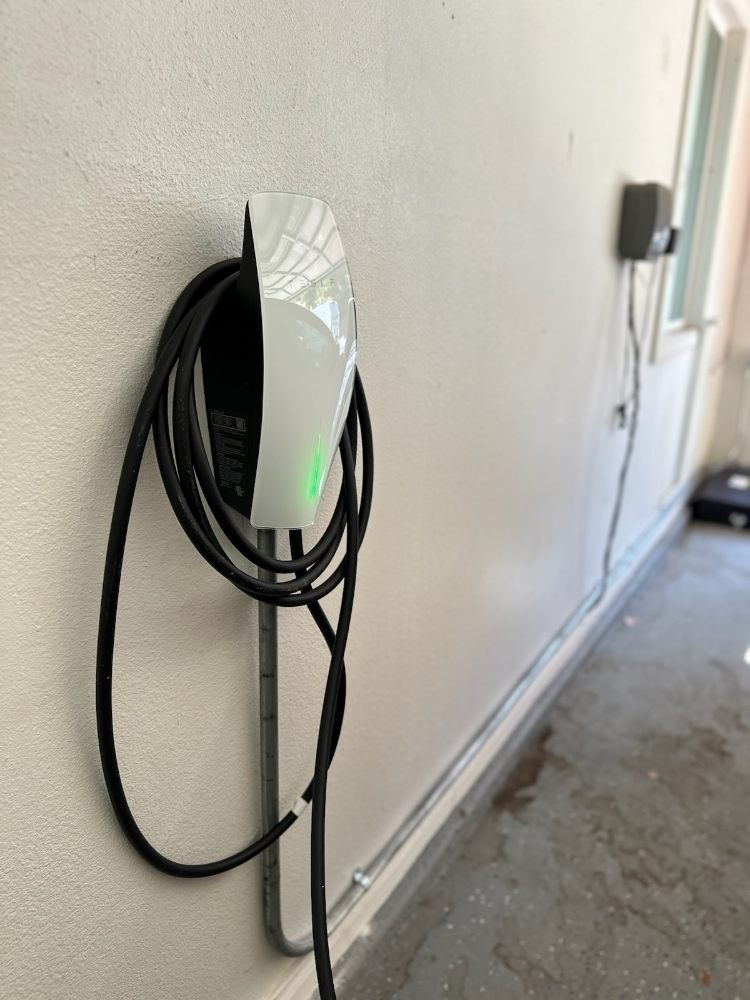
Some electric cars can power a house in an outage, but only when the vehicle and a bidirectional charger both support it and the home has equipment that disconnects it from the utility first. Many EVs can't send power out at all; others can run a few appliances from their own outlets, which is useful but isn't the same as backing up your home's circuits.
This is our fifth article for shutoff season. The pre-shutoff checklist covers getting ready, generator hookups explains transfer switches and interlocks, solar in an outage covers grid-tied systems, and home battery backup covers what a battery should run. This one covers the car in your garage.
Start with what your car can actually do
The California Public Utilities Commission's Public Safety Power Shutoff FAQ answers this question with "Probably not" for most cars: it says most EVs on the road can only receive power from a charger and don't have bidirectional capability, while a number of manufacturers have plans to release models that do.
The same FAQ also tells drivers to check with the manufacturer before using the battery for anything other than powering the vehicle. Do that before you plan around your car.
So the first two questions go to your automaker, not your electrician:
- Does my vehicle support sending power to a home, and with which charging equipment?
- What does my automaker say about using the battery to power a home?
Two very different ways to use an EV in an outage
Built-in outlets on the vehicle (vehicle-to-load)
Some vehicles have outlets on board, or an adapter from the automaker, that let you plug in an appliance with a cord, the same way you'd use a portable power station. Your owner's manual says whether your car has this and how much it can supply.
This can keep phones, a lamp or a small appliance going. It does not connect to your house wiring, and it shouldn't. Run the cord to the appliance itself, never to the house.
Powering your home's circuits (vehicle-to-home)
Vehicle-to-home means the car feeds your panel, or a set of chosen circuits, through a bidirectional charger. The U.S. Department of Energy's page on bidirectional charging says a bidirectional EV has to be paired with similarly capable charging equipment to send power to an external load, and that bidirectional vehicles can provide backup power to buildings or to specific loads.
This is a permanent electrical installation, much like a home battery system, and it needs three things to work:
- A vehicle that supports it. The automaker decides which models, model years and software versions can export power.
- A bidirectional charger that's compatible with that vehicle. The automaker and the charger maker decide which pairings work. Most home EV chargers send power only one way, into the car.
- Equipment that separates the house from the grid. Before the car powers anything, the house has to be disconnected from the utility's lines.
Never plug a car, or an inverter, into a wall outlet
When the grid goes down, your house is still connected to the utility's lines. Power pushed into a wall outlet, whether from a generator, a portable inverter or a cord from the car, can flow back out through your panel onto those lines. That's backfeed, and it is dangerous: it can hurt line workers repairing the system and your neighbors.
The CPUC's FAQ says that when a generator is connected directly to your home's wiring, you're responsible for making sure power doesn't flow into your utility's de-energized grid, and that you must contact your utility if you intend to use any backup power connected directly to your home's wiring. A cord with plugs on both ends is never the answer; our generator article explains why.
In a vehicle-to-home setup, the job of separating the house is done by transfer or isolation equipment that disconnects the home from the utility before the car starts supplying power, then reconnects it when the grid returns. The names and the hardware vary by manufacturer, so ask exactly what the system uses and where it mounts.
How much of the house can a car run, and for how long?
That depends on two things, the same two that decide what a home battery can do:
- How much energy the car's battery holds and will release. The Department of Energy's page puts a light-duty EV battery at approximately 15 to 100 kWh. How much of that the car will send to the house is set by the automaker, and you'll want charge left to drive; your automaker's app or manual explains any limits.
- What you ask it to run. A refrigerator and some lights are very different from central air, an electric range and a dryer running at once.
We won't promise a number of hours, because it changes with the car, the charger, the season and the loads. The planning is the same as for a home battery: decide whether you're backing up a short list of essentials or the whole house. The home battery article walks through critical-loads subpanels, whole-home backup and the big loads that drain stored energy fast. Most of it applies directly to a car.
Remember too that a car used for backup can't also be your way out. If an evacuation is possible, keep enough charge to leave.
The utility side: SCE, LADWP and city utilities
How a bidirectional system is reviewed depends on how it operates.
- SCE and the other large investor-owned utilities: a March 2024 CPUC staff presentation on charger interconnection described two paths for vehicle-to-home. A system that runs while connected to the grid must be designed to prevent sustained export, and the owner submits a non-exporting interconnection request under Rule 21. A system that runs only when disconnected from the grid, as backup, is treated as a microgrid where Rule 21 doesn't apply, and the owner submits backup isolated system information instead.
- Those rules are being revisited. The CPUC opened a rulemaking in August 2025 (R.25-08-004) to update its interconnection rules, and comments filed in it debate how backup-only vehicle systems should be reviewed. Expect the details to change.
- LADWP and city-owned utilities such as Burbank, Glendale and Pasadena set their own rules. Ask your utility before the system is energized.
Either way, the utility hears about it before the car powers the house. Those steps, and the local permit, are coordinated as part of the job.
California's direction on bidirectional EVs
Governor Newsom signed Senate Bill 59 on September 27, 2024. It authorizes the California Energy Commission, in consultation with the CPUC and the California Air Resources Board, to require battery electric vehicles of any weight class to be bidirectional-capable if the Energy Commission finds a sufficiently compelling use case for the driver and the grid. The law gives the authority; it doesn't by itself make any car bidirectional.
The Energy Commission's March 2026 business-meeting presentation on bidirectional charging lists power backup during an outage among the benefits of vehicle-to-home, and also says critical barriers to bidirectional charging remain.
What an electrician looks at
If your automaker confirms your car supports home backup and you've chosen compatible equipment, the house side is electrical work:
- Your panel and service. A load calculation shows what the house draws and whether the panel has the capacity and space for a bidirectional charger. An older or full panel may need a panel upgrade first.
- Where the isolation equipment goes, and how it connects between the utility service and your panel or a backup subpanel.
- Which circuits get backed up. Moving essential circuits to a critical-loads subpanel, if that's the plan.
- The charger circuit itself, run and protected the way the charger maker's instructions require.
Infinity Electrical Inc. (CSLB #1100231) installs EV chargers and connects battery backup systems across Los Angeles, Orange and Ventura counties. We don't sell vehicles, chargers or batteries, and compatibility between your car and a bidirectional charger is set by their manufacturers. Our EV charger page and backup power page cover the related work.
Questions to settle before you buy
- Does my automaker say this vehicle can power a home, and with which charger?
- What does my automaker say about using the battery for home backup?
- What equipment isolates the house from the grid, and where does it mount?
- Will it back up essentials or the whole house?
- Can my panel take the charger and the backup connection?
- What does my utility require before it's turned on?
FAQ
Can any electric car power my house?
No. The CPUC says most EVs on the road can only receive power from a charger; a vehicle has to support bidirectional power, and it has to be paired with a compatible bidirectional charger and isolation equipment.
Can I plug my car's outlet into a wall outlet to power the house?
No. Never feed power into a wall outlet: it can backfeed the utility's lines and endanger line workers and neighbors; use the car's outlets only to plug appliances in directly.
Is my regular Level 2 charger bidirectional?
Usually not. Most home chargers send power only one way, into the car, and the automaker and charger maker decide which bidirectional chargers work with which vehicles.
Do I need to tell my utility about vehicle-to-home backup?
Yes. The CPUC says you must contact your utility if you intend to use backup power connected to your home's wiring, and SCE, LADWP and city utilities each have their own process.
Planning EV backup power
Tell us which vehicle you have, what your automaker says it supports, the charging equipment you're considering and what you want to keep running. Send photos of your panel (open only the hinged door; never remove the inner cover) with the estimate form, or call (844) 430-7681. Free estimates on eligible work, and the price comes in writing before any work starts.